

If you keep up with the local news, you may have recently seen this headline: “'Kissing bug' disease is now endemic in US, researchers say. What you need to know.” On September 10, 2025, the CDC released a paper arguing for the label of “endemic” to be applied to the disease in the US. At Natural State, we consider it our duty to keep abreast of any news regarding pest-related illnesses and make this information available and easy to understand for our customers in Northwest Arkansas. Since this is our area of expertise, here’s our hysteria-free, zero fearmongering writeup on the kissing bug, Chagas disease, and what you and your family can do to protect yourselves.
1. What is a kissing bug?
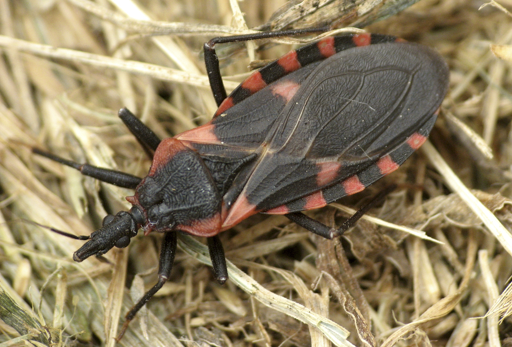
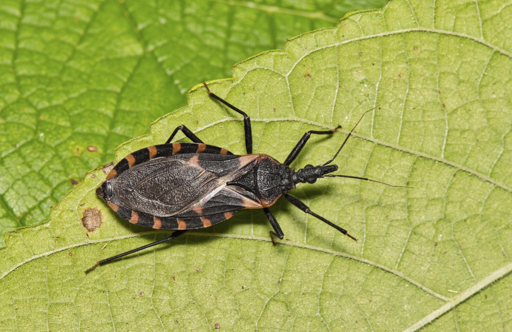
To get the scariest part out of the way, Triatominae insects (known to most as “kissing bugs” or “vampire bugs”) are a group of insects that feed on blood. Though they are most commonly found in Central and South America, in recent years new populations of kissing bugs have been confirmed in the Southwest regions of the United States, where most US species are found. However, one species, Triatoma sanguisuga, has a range from Texas to Pennsylvania, with the species’ presence noted in Arkansas. The species was first described in 1855, so some groups of kissing bugs have been native to the Southeastern United States for some time.
These bugs operate similarly to most insects that feed on blood: they find a suitable host and move into their nesting area, either by hitchhiking on the host or stumbling across the nest. Once they’ve established themselves in the host’s home, they feed when the host is asleep, then hide themselves during the day. Kissing bugs don’t just look for human hosts, though. Triatominae insects have been noted feeding on opossums, raccoons, rats, dogs, and cats. Once the bugs have had multiple blood meals, they begin molting to complete their life cycle.
Be advised that, from this point on, the descriptions of kissing bugs and their feeding habits will veer into gross-out territory. The name “kissing bugs” comes from the insect’s unfortunate habit of feeding on human hosts by biting them on the face, specifically around the mouth. Some species of Triatominae insect are known to defecate while feeding. This results in excreted material being moved into the host’s open wounds, eyes, or mouth when they reach up to rub or swat at the area that was bitten. Okay, we promise the worst of the gross-out stuff is over.
2. Trypanosoma cruzi and Chagas Disease
Kissing bugs are noted carriers of Trypanosoma cruzi, the parasite that causes Chagas disease. If the infected kissing bug’s feces enters into the host’s system, there is a chance that the host may become infected with the parasite. The usual symptoms upon infection are fever, rash, swollen lymph nodes, headaches, and localized swelling (in the area of the bite). These symptoms usually subside within 1–2 months, when the host’s illness would be classified as chronic. From this point on, 55% or more of infected people would have no more symptoms. For the other 45%, heart, digestive, and nerve issues may appear 10 years or more after the initial infection of the parasite.
If that strikes you as scary, we don’t blame you. The CDC argues that the label of “non-endemic” for Chagas disease in the United States no longer fits, as it can now be contracted inside US borders rather than from abroad. To take this with a grain of salt, consider this is an academic argument meant to advise doctors on a medical classification, not a guideline for all US residents. The paper cites statistics on Trypanosoma cruzi to make its argument, and we’d do well to pay attention to these numbers. The CDC reports that “A systematic literature review found 29 confirmed and 47 suspected cases of locally acquired Chagas disease during 2000–2018.” The paper goes on to report that they expect these numbers to be an underestimation of actual cases. Though those numbers sound high, we must take into account that these cases were distributed over 8 states and 18 years. While these numbers do include an unknown number of cases in Arkansas, the CDC also reports that “shared risk factors included rural residence, history of hunting or camping, and agricultural or outdoor work.” There is not an immediate threat to most residents of Northwest Arkansas. So while these numbers may be cause for concern, they are not cause for alarm. The presence of kissing bugs and their parasitic hitchhikers is something residents of Northwest Arkansas should be advised of, but not lose sleep over.
3. Forewarned is Forearmed
The CDC’s argument for updated guidelines does reveal the most common factor in human infection of Trypanosoma cruzi: man’s best friend. It seems that most human infections were transmitted from canines. This is likely due to dogs’ greater potential exposure to other infected mammals, including opossums, raccoons, or rats. Since kissing bugs can also bite canines outright, it’s worthwhile to keep an eye on any outdoor pet bedding, laundering it frequently.
As for keeping kissing bugs away from your home, integrated pest management is the most highly recommended method for prevention. Sealing up cracks in doorways, flooring, siding, and windows that bugs can use as an entry point is a great place to start. From there, a pesticide barrier for the exterior of your home (like our Home Defense service) is an ideal second level of protection, since no home can be perfectly sealed. For a quote on recurring pest control services that are effective against kissing bugs and the rest of Arkansas’ resident pests, call our office at 479-927-6350 for a quote today.